Corporate America may be failing ambitious women: McKinsey report
Women in the United States are less ambitious when it comes to building a career, now that many companies have stepped back from supporting career opportunities. There is now a gap between the professional ambitions of women and men, according to McKinsey & Company’s recent report ‘Women in the Workplace 2025’.
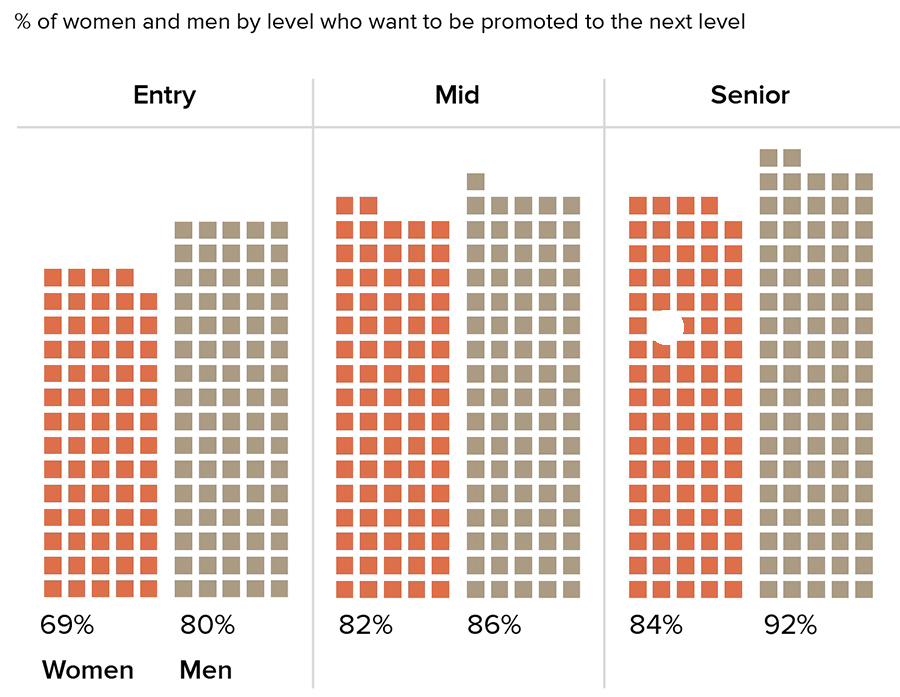
Women and men at all levels are equally committed to their careers and motivated to do their best work. But for the first time, there is a notable ambition gap, according to the report. Eighty percent of women want to be promoted to the next level, compared to 86% of men – and the gap widens significantly at entry and senior levels.
The results of a report, which surveyed around 9,500 employees working at companies in a variety of different industries, found that 69% of women at the beginning of their careers were hoping for a promotion, compared with 80% of men in the same early career stage.
Source: McKinsey & Company
Less support for women
Overall support for women in the workforce has been declining. While 88% of companies said they are fostering inclusivity and 78% are pushing more gender diversity, only 54% are focused on women’s career advancement, with less still for women of color. That is less than in previous years’ reports.
“We don’t have a women’s leadership program anymore – and we had to reimagine our women’s leadership training,” said one HR leader surveyed in the report.
“We took elements of the training and shared it broadly through our employee resource groups. It means some of the content is still available to women – but it’s informal, rather than a comprehensive program.”
GRAPH: “… And entry-level women miss out on the most impactful kinds of sponsorship” (pg 5)
Women are also less likely to benefit from professional guidance. Only 31% of women in entry-level positions have a sponsor, compared to 45% of men in similar positions. At senior levels, women are still less likely to enjoy any sort of sponsorship.
This lack of sponsorship is important. The report notes that employees with sponsors are twice as likely to be promoted as those without. A total of 65% of workers with a sponsorship were promoted in the last two years. That is compared to only 35% of those that are not sponsored.
AI and productivity
Technology use is another area where the gender gap has become more evident. The report found that male employees are more encouraged to use AI tools than women. AI tools have been shown to lead to greater efficiency and success in certain functions – if women are left behind in this crucial area, it could mean the gender gap widens.
This growing technology-related gender gap may also explain why women face more burn-outs than men, when AI tools are largely easing the work load on workers in many different industries. For example, 60% of female respondents in high-level roles reporting having a burn-out, compared with 50% of males in the same level of position.
Domestic work
The role of women in carrying out domestic work should not be underestimated as it relates to these findings. Shifting to domestic work can be a big part of what ends up driving women away from ambitiousness in their careers.
Despite leaps and bounds in gender equality in recent years, women are still more often than not the ones tasked with child care and caring for older family members. The report found that a full quarter of female respondents said they would not take a promotion if it meant more responsibilities added on to their personal commitments, which are already often so taxing.
Scaling back of DEI
Many American companies and (perhaps more notably) federal agencies have started a significant reduction in their diversity, equity, and inclusion (DEI) programs over the past two years. This trend is largely driven by a shifting legal landscape following high-profile court rulings and new executive orders from the Trump administration that target specialized identity-based initiatives.
Several organizations are choosing to rebrand their existing efforts with more neutral terminology such as workplace culture or merit-based professional development to avoid public controversy. While many industry leaders have dismantled their diversity departments, a smaller group of companies have continued to maintain these programs as a core part of their long-term business strategy.
“This year, only half of companies are prioritizing women’s career advancement, part of a several-year trend in declining commitment to gender diversity,” the McKinsey report notes.
“This is a solvable problem, but it requires a greater investment in women’s careers at a time when a number of companies may be deprioritizing them. Corporate America has made real progress in women’s representation over the past decade – and companies that prioritize gender diversity see bigger gains. For companies that lost focus this year, 2026 should be the year of recommitting to women in the workplace.”
link