Inside the Queen’s consulting pipeline: How students are climbing the consulting career ladder

Somewhere between high-stress case competitions and nerve-wracking coffee chats, the nerves turn into confidence, and consulting becomes a top career prospect for many Queen’s students.
With graduation on the horizon for most fourth years, the inevitable question of what they’re doing next year seems to appear more with each passing week. While some aren’t sure just yet, others have worked tirelessly throughout their degree to shape their career options post-grad. While many career paths capture the interest of Queen’s graduates, finance takes the top spot for business graduates at 35 per cent. In second place, with 20 per cent of Smith School of Business graduates going into consulting, the field appeals to problem solvers looking to work across a variety of industries.
Over the past decade, Queen’s has consistently ranked among the top feeder schools for consulting firms in Canada, particularly from Smith School of Business. With multiple clubs, and a variety of student initiatives and case competitions, the culture and opportunities available through Smith expose many students to the industry as early as first year.
A mature career aspiration, consulting presents a variety of complex problems. “Students are very bright and ambitious, and they want to solve complex and difficult challenges, and so consulting provides an opportunity to solve varied and diverse problems,” said Charlie Mignault, a Smith professor and director of Smith Business Consulting, in an interview with The Journal.
What exactly these “complex and difficult challenges” are proves harder to define.
“It’s one of those industries, or sort of roles where people will say; how would you describe it to your grandmother and people […] often don’t really know how to describe it,” said Emma Sutherland, former consulting recruiter and manager of Career Education and Coaching at Smith, in an interview with The Journal.
Difficult to define, yet a highly sought-after career among Queen’s students, The Journal set out to understand the Queen’s consulting pipeline.
Consulting 101
Consulting’s the provision of third-party advice and expertise, often to a company, but sometimes to governments or other organizations. This often involves breaking down complex problems and using data to solve them.
“Management consulting is about helping organizations make better decisions and perform at a higher level […] using data analysis and strategic thinking,” Mignault said.
Andreas Lucas, Comm ’26, has some experience working in startup consulting and sat down with The Journal to discuss his generally positive experience. “I think a general definition is its [consulting] a professional service where you solve complex issues, you make strategic decisions, and you work on improving performance for others,” Lucas said.
Consultants can advise on a wide range of topics, from strategy, to operations, digital transformation, and marketing. Prospective consultants can choose to specialize in niche topics, including sustainability, technology adaptation, or startup consulting.
Mignault explained some of this diversity and the opportunity for growth within consulting. “Some people, when they start, they’ll evolve and move in their role, into […] strategy, work that focuses on growth, competitiveness, go to market strategies, for example, then other people will focus on operations […] things like efficiency plays or supply chains.”
Almost anyone or anything could require advice from a consultant. Mignault described having a defence fellow from the Canadian Military come present to his class. “He said to me afterwards, I’d love to take everyone from our team [Smith Business Consulting] and bring them into the Canadian Military to help solve these big challenges we have,” Mignault said.
Other communities that’ve sought the help of Smith Business Consulting include small townships surrounding Kingston. In 2021, a team of Queen’s students helped the town of Gananoque develop a new sustainability plan, which outlined short and long-term energy use in the town. Mignault also recounted a group of students who worked on a sustainability action plan for the city of Brockville.
Sutherland described consulting as “working within a number of different industries […] to really help your clients to figure out the answer to an issue they might be experiencing.”
There’s no shortage of clients in Canada. The consulting industry is experiencing solid growth, valued at $11.94 billion USD in 2025, particularly in sectors like data analytics and environmental and social governance.
Growth in employment for management consulting from 2025 to 2023. Graph from: Mordor Intelligence
While highly valued consulting can have long hours and late nights. Many consultants report working between 50 and 80 hours a week. “Absolutely, there are long nights, there are sleepless nights, you know, sitting at a computer, but again, it depends on the firm,” Lucas said.
However, Lucas also expressed how long hours are a part of many entry-level jobs, and for some, the final product is worth it. “It’s more or less about the destination than the journey,” he said.
Ranging from advising multinational corporations to small communities, consultants are tasked with a variety of challenges across various industries and sectors. While the demanding workload may be a factor, for some, it’s a worthwhile investment in professional growth and meaningful work.
Consulting’s appeal
Long hours and intense analysis aren’t for everyone, yet Smith students are active in clubs and case competitions, with 15 to 20 per cent of graduates going into consulting each year.
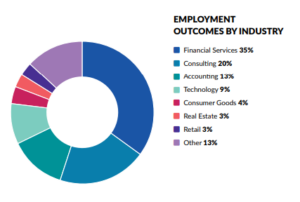
Consulting at 20 per cent of employment outcomes for Smith School of Business graduates. Graph from: Smith School of Business BCom 2024 Employment Report
“I definitely talk to a lot of people interested in consulting, I would say the big two [careers after business school] are finance and consulting, in terms of popularity,” Lucas said.
Mignault spoke to the excitement and sense of purpose that often draws students into consulting. “They [consultants] set a path for growth, or they knock back barriers to change and develop recommendations that […] change the trajectory of an organization, and I think that’s incredibly rewarding,” he said.
For students like Alex Dewar, Comm ’29, the prospect of influencing strategy and driving improvement is a major source of motivation. “People would look up to me and look for my answer, and I like that type of control,” she said in an interview with The Journal.
Roles could range from helping a struggling business gain stability, to advising multinational corporations and governments. Consultants frequently make critical decisions that have lasting impacts.
However, succeeding in such a high-impact industry often requires more than just technical expertise. According to both Mignault and Sutherland, the ideal candidate for a role in consulting is a combination of motivated, analytical, and communicative. They aren’t just problem solvers, but storytellers. Consultants must be able to sift through data and present clients with a compelling storyline.
“At its basis, it’s really about that problem solving and working with different solutions to do that,” Sutherland said. She added that strong interpersonal skills were just as important as intellectual ones, as consultants often work closely with clients to navigate change and uncertainty.
While consultants stem primarily from Smith Business, any student with a passion for problem-solving can get involved. Both Sutherland and Mignault described working with engineers who were passionate problem solvers.
What matters seems to be problem-solving capabilities, and what Mignault described as a “bias for action.”
A part of consulting’s appeal appears to be in the intrinsic satisfaction of solving complex problems and generating new ideas. For some students, consulting offers the opportunity to engage with real-world challenges, whether they’re working with small businesses or multinational corporations.
“It’s a wonderful opportunity to change and improve the world around you, the work that consultants do has a high impact and is highly valuable to the organizations they’re working with,” Mignault said.
Consulting’s sense of impact is reinforced through collaboration. Consulting projects often involve teamwork, and constant idea sharing and debate.
“Consulting is a very strong career choice for anyone,” Lucas said, “I think the main reason people go into it is that they like working with teams, coming up with new ideas, and being creative, which is great.”
Another part of consulting’s appeal is who it gets you in the room with. Entry level analysts could be working directly with the C-Suite executives of large corporations. While the intensity and frequency of this interaction may vary, senior consultants and partners often act as trusted advisors to top management.
“You have exposure to the C-suite, to board members, and so you get immersed in executive-level challenges early in your career […] that definitely will create this sort of fast career acceleration of that’s what you’re looking for,” Mignault said.
Even within consulting, there’s lots of room for upward mobility. Mignault and Lucas described consulting as a “ladder industry,” where you start as a low-level analyst and work your way up to more executive, influential positions. But in terms of working across a variety of industries, consulting gets you in the door with important people early on.
That said, not everyone’s sure they want to be a consultant. Dewar highlighted that while she’s interested in consulting, she’s keeping her options open. “I don’t want to get set on one position and not be able to go back and change my mind,” Dewar said.
While unsure of her career path going forward, Dewar expressed that consulting appealed to her because she could have decision-making power and be a part of something bigger than herself.
While Dewar is a potential candidate for consulting, not everyone fits the bill. Sutherland described common misconceptions about consulting, particularly that it includes a lot of travel and glamorous client meetings. Sutherland expressed how in reality, much of the work takes place behind the scenes during long hours of research and data analysis.
Rather than excitement, consulting requires discipline and a willingness to engage with complex problems. Sutherland explained how success in consulting often depends less on prestige and more on attention to detail and problem-solving skills.
These misconceptions highlight the need to evaluate what one is truly passionate about. “What do you love to do? That [question] requires us to be a bit reflective and also to take a step back from what we call the noise of consulting,” Sutherland said.
Rather than being swayed by the prestige or popularity of consulting, students are advised to consider whether the day-to-day realities of the job align with their interests, values, and long-term goals.
While a viable and sought-after career path among Queen’s students, consulting is competitive and may not be the best fit for everyone. As Sutherland, Mignault, and Lucas highlight, behind the prestige lies demanding work that requires a genuine passion for problem-solving.
Consulting “culture” at Queen’s
According to Dewar, Queen’s students are exposed to consulting as early as first year, where the Smith Schol of Business has a variety of clubs, case competitions, and courses related to consulting.
“We do have a lot of students who go into consulting, and that builds a community of like-minded students who want to develop critical thinking and problem-solving skills to help them succeed. You could call that a culture of sorts.” Sutherland said.
The pervasiveness of consultancy aspirations among students isn’t necessarily pressure; for Lucas, it’s encouragement and the opportunity to connect with like-minded individuals. Consulting pathways provide access to mentors, peers with similar ambitions, and a structured introduction to a competitive industry.
“There’s a maturity around the student’s career aspirations and there’s a lot of reflection and culture that supports […] them [students] getting into management consulting,” Mignault said.
Without the opportunity for a formal co-op in Smith Business, clubs can help students get ahead and gain real world experience.
“The consulting clubs are very popular, and they’re very strong, and they look great on a resume,” Lucas said.
The Queen’s Consulting Association is one of the largest consulting clubs on campus, with over 800 members. Other consulting clubs based out of Smith include CREO solutions and FreshSight. The Journal reached out to the executives of all three clubs; however, no one responded in time for publication.
Smith School of Business also facilitates case competitions, events where student teams analyze real or simulated business problems, develop strategic recommendations, and present them to a panel of judges.
While offering a lot of opportunity, these clubs can be competitive and prestigious. “Clubs are supposed to be promoted as fun and interesting,” Dewar said, “the consulting, investment banking, and finance ones are seen as more prestigious.”
Dewar described how classmates of hers had to go through extensive resume building and interview processes just to be considered for consulting clubs.
Another esteemed option for students interested in consulting is Smith Business Consulting (SBC). SBC is a three-credit student-run management consulting firm that operates out of the Smith School of Business. They provide real consulting services to small to medium sized businesses, nonprofits, and public institutions, focused on strategy, marketing, finance, and operations. Including the City of Kingston, and Kingston Economic Development.
Director of SBC, Mignault spoke to the reputation and influence of the program. “Over 100 students apply every year […] they’re in a performance environment where they have a paying customer who’s relying on their recommendations to help the firm grow and prosper.”
Mignault highlighted how the program is “really much more than a classroom lecture.”
Again, Smith students don’t have the opportunity for co-op, so SBC offers an avenue for students to get experience in real life consulting scenarios, and are often recruited by top firms including McKinsey & Company, BGC, KPMG, and Deloitte.
For those like Dewar, who may be unsure of their future career path, opportunities like SBC can be critical in navigating the confusing world of post grad options.
Another element of consulting culture at Smith is the engaged alumni network. With Queen’s graduates working at major consulting firms across Canada and internationally, current students benefit from a system of mentorship and access to connections. These alumni will often return to campus for recruitment events and career panels, making themselves accessible to aspiring consultants.
“There’s so many Queen’s grads in the consulting field in Canada that there’s these natural linkages and communications and so there’s great exposure,” Mignault said. For students looking to break into the competitive world of consulting, these connections can be a critical leg up.
The alumni network can help students get in the door with consulting firms or just get an introduction to the industry if they’re interested. For students that aren’t sure if they want to be consultants, Sutherland recommended “having coffee chats with people, for example, with previous commerce students who maybe are in consulting.”
These conversations can help alleviate some of the pressure and indecision that comes with choosing a career.
For many, there’s a clear and observable culture—including prestigious clubs and case competitions—around consulting at Queen’s. While high pressure, the culture allows students to have hands-on experience working in consulting and engage with alumni who could further their career aspirations.
***
For many prospective graduates, consulting stands out as a top pathway. Supported by an extensive network of clubs, alumni, and experiential learning, Queen’s has cultivated a pipeline that does its best to prepare students for the competitive industry.
After nearly a decade working with students interested in consulting, Mignault remains inspired by the hard work and dedication of prospective consultants.
For Dewar, consulting remains a promising career option, while she continues to explore the options available to her. In all, the demand of the industry draws ambitious and competitive students with a commitment to solving problems.
Tags
Consulting, Queen’s, Smith School of Business
All final editorial decisions are made by the Editor(s) in Chief and/or the Managing Editor. Authors should not be contacted, targeted, or harassed under any circumstances. If you have any grievances with this article, please direct your comments to [email protected].
link